JayJay here. I found these items pertaining to the Marvel Try-Out Book that may interest you. Jim is presently typing his two fingers to the bone to get today’s post done, so that will be up later!

~P~ said…
Count me as yet another young hopeful, whom, after bleeding art and story on paper, I would swaddle my creations and send them “down the Nile” to the Marvel Submissions Office.
In the mid 1980’s I had sent in a few samples of “panel-by-panel continuity” (as the office called it) and always received some encouraging replies (even though they were rejections). They may have been signed by YOU, Jim. (I saved these letters for many years, but think they were lost in a relocation.)
One time in the late 1980’s, I sent in an original submission (an originally conceived horror story – no superheroes, just various types of architecture, creepy settings, and some nasty doings with top-hatted gentlemen, rabid dogs, rats, a burning castle and a vile succubus at the end).
The reply that I later received in the mail was photocopies of practically the entire volumes of some of Andrew Loomis’ books; “Figure Drawing for All It’s Worth” and another about film techniques and direction.
The letter included in the packet told me that they thought that I had a lot of “very close, but not quite there yet” talent, and that I should cram on the pages of the photocopied volumes.
While I would love to state that you were the correspondent, instead, the reply came from Carl Potts.
The only other time I received such deep, encouraging replies was from Mike Friedrich, to whom I had sent samples after being told to do so by Norm Breyfogle, after his seeing my work.
Neither venture led to any work, or any further contact past that point. Much of the blame falls upon my own shoulders, for not hammering out sample after sample (while striving to improve myself at each go-round).
Truthfully, I felt that I didn’t want to “make a nuisance of myself” and avoided trying to jam my foot in the door (which, I guess would have been the better way to go).
Anyway, while I did manage to get a few independent comics under my belt (as writer and illustrator), the implosion of the 90’s sort of shut the door on that.
But, I will ALWAYS be grateful to ANYONE who takes the time to actually LOOK AT and REPLY TO (hopefully, with encouragement) the blood, sweat and tears of hopeful talents.
These days, there are reality shows dedicated to trying to find the “next big thing” but when I was younger, no one wanted to even look at you.
Thank you, Jim.
And thanks to any like you who know what it’s like to be on the outside looking in – waiting… waiting… for a chance.
~P~
September 2, 2011 9:46 PM

Submissions, I was told. People were always sending in samples and submissions.
“What do you do with them?”
Nothing, someone said. Hold onto them for a while. Sometimes, when Stan was out of town and his secretary got bored, she’d return some, unopened. If the pile got too big, they’d just throw them all away.
I asked if I could take care of them. Answer, words to the effect, “Knock yourself out.”
It was 1976. I was brand new associate editor, fresh from Pittsburgh Pennsylvania. All my friends were back in the “Burgh. My girlfriend was back in the ‘Burgh. I didn’t have a lot to do after work except more work. And, occasionally hang out with the other new guy, Roger Stern. So, every night, I took a dozen or three of those submissions home with me.
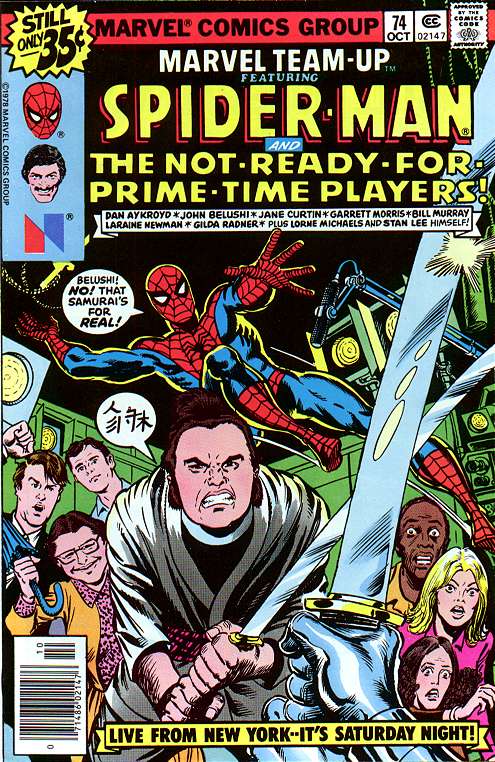
Sometime in early 1978, Chris Claremont proposed that Spider-Man meet the “Not Ready for Prime Time Players” in an issue of Marvel Team-Up.
For any of you who were born last week, the Not Ready For Prime Time Players are the cast members of Saturday Night Live. If you don’t know about SNL then ask mommy if you can stay up late one Saturday night or, better yet, check out the Saturday Night Live DVDs that contain classic material, like SNL The First Five Years or The Best of John Belushi.
SNL was the hipness barometer back in those days. If, on Monday morning, you weren’t guffawing about “Samurai Delicatessen” or “Weekend Update” around the coffee shrine you probably still wore white socks and put pennies in your loafers.

I came across some things that relate to previous posts and comments. JayJay, the brilliant Blog Elf will provide links to the discussions.
The Famous ROM #1 Cover That Wasn’t
Here is the unused cover for ROM #1 penciled by Michael Netzer:

I haven’t read Moench’s comments, but I would assume he blamed Shooter for the above incident with the infested motel/cold Marvel office (though Shooter was not directly involved in the situation or even aware of it as far as I know). Chronic kidney problems can be a contributory factor in heart disease, so I assume he then blames the situation for ultimately causing Gene’s death.
“I must say it’s very impressive that you’ve saved so many items from your tenure at Marvel, and I assume, the rest of your career.
Is this some sort of an Obsessive Compulsive Disorder-kind of thing, or did you one day make a conscious decision to save everything for posterity?”
Toward the end of my time at Marvel, Marvel’s upper management duo, Galton and Calamari, along with Shelly Feinberg and a few other Cadence bigwigs (as “CMI” — Cadence Management Inc.) had taken Cadence, Marvel’s parent, private and sold the Marvel division to New World Entertainment (NWE). Throughout the process, as they furthered their quest to cash in and line their own pockets on what we, the comics people had built, they took certain unethical and, I believe, illegal steps.
I was senior enough that all I had to do was keep my mouth shut, help them sell my troops down the river and I would have been handsomely rewarded. One executive on a lower level than I ended up with a $3 million payoff. Mine would have been bigger, if I had merely cooperated.
I chose instead to become a “labor leader.” As the pension plan was cashed out, benefits were withdrawn, health coverage was diminished, etc., all done to fatten cash flow to increase the value of CMI’s sale-price multiple, I resisted. They even tried to retroactively eliminate the royalty plan. That battle I won — by threatening a class action lawsuit. At the top of my lungs.
Sometime in February, 1984, my secretary (it was okay to say “secretary” in those days) the wonderful Lynn Cohen told me that Bill Sarnoff was on the phone. Not his secretary, Bill Sarnoff himself, holding for me.Great Scott!
Bill Sarnoff was the Big Cheese, I forget his exact title, of the publishing arm of Warner Communications. Among the operations under his purview was DC Comics.
Bill introduced himself, as if that was necessary. What he wanted to talk about was licensing the publishing rights for all DC characters to Marvel Comics.
Holy hegemony, Billman!
Bill said, more or less, that Marvel seemed to be able to turn a substantial profit on publishing comics, as opposed to DC, which consistently lost money, a lot of money, and had for a long time. On the other hand, LCA (Licensing Corporation of America), Warner’s licensing arm did very well with the DC properties, while Marvel “didn’t seem to do much licensing.”
I guess the few million a year we made from licensing, mostly from Spider-Man, seemed paltry to him, what with the fortune that just their big four, Superman, Batman, Robin and Wonder Woman brought in.
I told him I thought Marvel would be very interested, and that I would discuss it with Marvel’s President, Jim Galton.
So, I did. I told Galton about my conversation with Sarnoff. Galton said he’d give Sarnoff a call.
The next day, I went upstairs, poked my head into Galton’s office and asked whether he’d called Sarnoff and, if so, how that went?
Galton said he told Sarnoff we weren’t interested.
I was stunned. Why not?!
Powered by WordPress & Theme by Anders Norén
