
~P~ said…
Count me as yet another young hopeful, whom, after bleeding art and story on paper, I would swaddle my creations and send them “down the Nile” to the Marvel Submissions Office.
In the mid 1980’s I had sent in a few samples of “panel-by-panel continuity” (as the office called it) and always received some encouraging replies (even though they were rejections). They may have been signed by YOU, Jim. (I saved these letters for many years, but think they were lost in a relocation.)
One time in the late 1980’s, I sent in an original submission (an originally conceived horror story – no superheroes, just various types of architecture, creepy settings, and some nasty doings with top-hatted gentlemen, rabid dogs, rats, a burning castle and a vile succubus at the end).
The reply that I later received in the mail was photocopies of practically the entire volumes of some of Andrew Loomis’ books; “Figure Drawing for All It’s Worth” and another about film techniques and direction.
The letter included in the packet told me that they thought that I had a lot of “very close, but not quite there yet” talent, and that I should cram on the pages of the photocopied volumes.
While I would love to state that you were the correspondent, instead, the reply came from Carl Potts.
The only other time I received such deep, encouraging replies was from Mike Friedrich, to whom I had sent samples after being told to do so by Norm Breyfogle, after his seeing my work.
Neither venture led to any work, or any further contact past that point. Much of the blame falls upon my own shoulders, for not hammering out sample after sample (while striving to improve myself at each go-round).
Truthfully, I felt that I didn’t want to “make a nuisance of myself” and avoided trying to jam my foot in the door (which, I guess would have been the better way to go).
Anyway, while I did manage to get a few independent comics under my belt (as writer and illustrator), the implosion of the 90’s sort of shut the door on that.
But, I will ALWAYS be grateful to ANYONE who takes the time to actually LOOK AT and REPLY TO (hopefully, with encouragement) the blood, sweat and tears of hopeful talents.
These days, there are reality shows dedicated to trying to find the “next big thing” but when I was younger, no one wanted to even look at you.
Thank you, Jim.
And thanks to any like you who know what it’s like to be on the outside looking in – waiting… waiting… for a chance.
~P~
September 2, 2011 9:46 PM
Category: 03 Marvel Comics Page 5 of 10

Submissions, I was told. People were always sending in samples and submissions.
“What do you do with them?”
Nothing, someone said. Hold onto them for a while. Sometimes, when Stan was out of town and his secretary got bored, she’d return some, unopened. If the pile got too big, they’d just throw them all away.
I asked if I could take care of them. Answer, words to the effect, “Knock yourself out.”
It was 1976. I was brand new associate editor, fresh from Pittsburgh Pennsylvania. All my friends were back in the “Burgh. My girlfriend was back in the ‘Burgh. I didn’t have a lot to do after work except more work. And, occasionally hang out with the other new guy, Roger Stern. So, every night, I took a dozen or three of those submissions home with me.
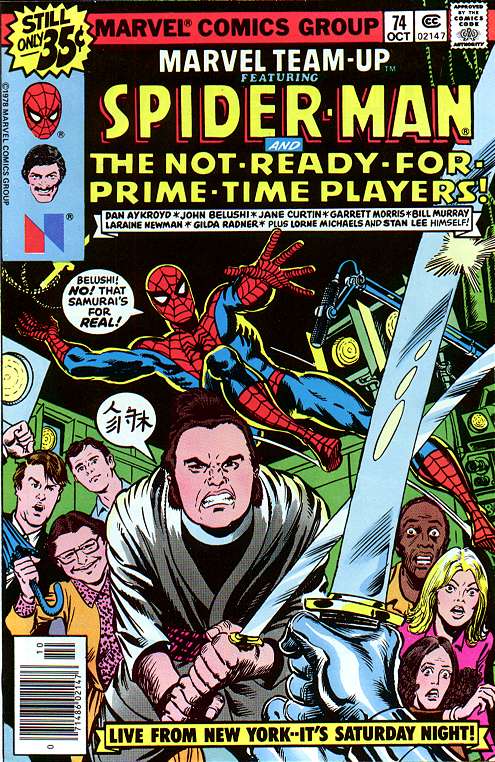
Sometime in early 1978, Chris Claremont proposed that Spider-Man meet the “Not Ready for Prime Time Players” in an issue of Marvel Team-Up.
For any of you who were born last week, the Not Ready For Prime Time Players are the cast members of Saturday Night Live. If you don’t know about SNL then ask mommy if you can stay up late one Saturday night or, better yet, check out the Saturday Night Live DVDs that contain classic material, like SNL The First Five Years or The Best of John Belushi.
SNL was the hipness barometer back in those days. If, on Monday morning, you weren’t guffawing about “Samurai Delicatessen” or “Weekend Update” around the coffee shrine you probably still wore white socks and put pennies in your loafers.
Sometime in February, 1984, my secretary (it was okay to say “secretary” in those days) the wonderful Lynn Cohen told me that Bill Sarnoff was on the phone. Not his secretary, Bill Sarnoff himself, holding for me.Great Scott!
Bill Sarnoff was the Big Cheese, I forget his exact title, of the publishing arm of Warner Communications. Among the operations under his purview was DC Comics.
Bill introduced himself, as if that was necessary. What he wanted to talk about was licensing the publishing rights for all DC characters to Marvel Comics.
Holy hegemony, Billman!
Bill said, more or less, that Marvel seemed to be able to turn a substantial profit on publishing comics, as opposed to DC, which consistently lost money, a lot of money, and had for a long time. On the other hand, LCA (Licensing Corporation of America), Warner’s licensing arm did very well with the DC properties, while Marvel “didn’t seem to do much licensing.”
I guess the few million a year we made from licensing, mostly from Spider-Man, seemed paltry to him, what with the fortune that just their big four, Superman, Batman, Robin and Wonder Woman brought in.
I told him I thought Marvel would be very interested, and that I would discuss it with Marvel’s President, Jim Galton.
So, I did. I told Galton about my conversation with Sarnoff. Galton said he’d give Sarnoff a call.
The next day, I went upstairs, poked my head into Galton’s office and asked whether he’d called Sarnoff and, if so, how that went?
Galton said he told Sarnoff we weren’t interested.
I was stunned. Why not?!
Chicago was a terrific show that year. Among other things, I remember meeting this aspiring young artist, a kid named Mark Silvestri. I liked his stuff. Claremont heard about it and swooped down on him like a mutant hawk.
When at conventions I often took con people and creators, especially Marvel creators, to lunch or dinner on Marvel. It was a little thank you for all they did, for representing Marvel at the con, for general good will and PR. You know. So, one afternoon, I asked a couple of Marvel guys if they’d like to have dinner at Lowry’s. Lowry’s is a classy Chicago joint famous for its prime rib, in case you are a vegan and therefore unaware of notable carnivore hangouts.
Len Wein and Marv Wolfman overheard me and asked if they could come along. Well…both were DC guys at that point, but, why not? They’d done plenty of dinners’ worth of work for Marvel, and…why not?
I’d learned that, being Editor in Chief of Marvel, if I attended a panel, often I was asked to participate, though usually I just wanted to listen. So I tried to be inconspicuous.
Yes, it is difficult to be inconspicuous when you’re six-foot-seven. Stop laughing.
Howard Cruse sent me a letter sometime in the mid-1980’s asking about the rights to some Barefootz stories he had created for Marvel some years ago. On his website his is how he describes how that came about and how it went:


Near the end of 1980 or very early in 1981, Stan turned up at my office door as he did occasionally, usually when there was something bothering him. He closed the door—always a bad sign—and sat down in the guest chair. He had a letter in his hands.
He said it was a complaint about what a terrible Editor in Chief I was. The main crime alleged was that I was allowing an artist named John Byrne to ruin the Fantastic Four.
“Dear Jim,
Despite disagreeing considerably with a number of points you make in your letter of April 9 (as you obviously did with some of mine, made in the previous letter), I was glad to see we’re not really all that far apart.
For my own part, as I tried to make clear, I have made a solemn vow (to myself) to let bygones be bygones, and if possible, to avoid adverse comment on Marvel and its policies. I’ve even long regretted the fact that your elevation to the position of editor-in-chief, in which you’ve obviously done a fine job, came at a time after I’d moved to the West Coast. Perhaps if we’d had more personal communication from 1977 to 1980, we could have come to some sort of agreement at that time or at least parted under more amicable circumstances. I leave it to you to decide if we should ever make any attempt to rectify that situation; certainly I’ve never been a grudge-carrier in other cases, and our differences– if we ever sat down and talked about them — are hardly insurmountable, even if we never happen to work for the same company at the same time again.”
The letter goes on to further discuss several matters, including Marvel’s reprint policy, the pending X-Men movie, and others.
One afternoon toward the end of April, 1980, I got a call from Marvel President Jim Galton. He said that Roy Thomas had asked for a meeting with him to discuss renewing his contract with Marvel.
Roy had written a letter dated April 10 (I have the original) to Galton informing him that he had not been able to work out a new contract with me and that he was leaving Marvel. That prompted the call I got from Galton immediately thereafter. He said, among other things, that he thought I’d told him Roy and I had worked out a deal. What happened? What went wrong? How could I lose Roy?
Do you know how important to Marvel Roy must have been for Galton to even know who he was? Galton, the same man who once asked me who Gene Colan was. Galton, who didn’t know who John Byrne was. Or John Buscema. Or anyone else, except Chris Claremont, who had an uncanny (←heh) knack for running into Galton on the elevator and introduced himself.
But Galton knew Roy, the man who had gotten us the Star Wars license among many other things.